
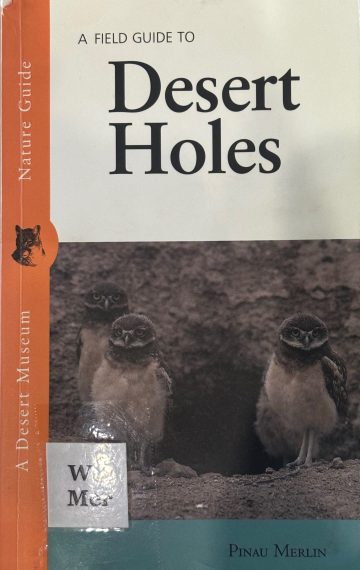
Call Number: W Mer
- Publisher: Arizona-Sonora Desert Museum Press
- Publication Date: 1999
- ISBN: 9781886679238
- Format available: Paperback
- Number of copies: 2
Description:
A Field Guide to Desert Holes By Pinau Merlin
Book review by Rebecca Luczyk, SCVN Librarian
Walking around Sabino Canyon, you can’t help but notice a variety of holes, divots, depressions, and shelters along paths, around rock crevices, and under trees, bushes, or sandy areas.
This book has over 50 full-color photographs and 60 drawings of desert animals, their holes and tracks. It tells you what animals live in various-sized ground holes, or in depressions, mounds, and elevated holes, plus what animals tend to borrow and modify shelters built by others. Reptiles, insects, and many other desert animals find safety and shelter in these holes.
Below are just a few of the most common holes you may have seen:
• Pocket mice make mounds of dirt which are pocked with many holes creating a Swiss cheese effect. Their holes range from one-half inch to one-and-one-half inches in diameter.
• Many one-and-a-half to two-and-a-half-inch holes (often found out in the open) are created by the social, round-tailed ground squirrel.
• The Harris’ antelope squirrel digs two to two-and-a-half-inch holes, with no mound of dirt, and often burrows under cactus. Although many holes may appear to be inhabited, only one hole is used by this solitary squirrel; it often leaves tell-tale evidence of small bits of uneaten cactus near its entrance.
• The white-throated wood rat or packrat excavates multiple holes of three to five inches at the base of a prickly pear, mesquite tree, or cholla cactus. Tell-tale signs also include large mounds of sticks, cactus joints, and debris outside its hole.
• Grasshopper mice can build small one-and-one-half inch holes at the base of a plant or bush but are found more often in open areas with sparse grass. They are fierce predators of pinacate beetles, scorpions, and other mice!
• Kangaroo rats may build up to twelve large mounds where three-to six-inch tall oval holes are dug in sandy open desert scrub. They are found where grasses are dispersed among mesquite and creosote. Kangaroo rats are solitary and will fight if they encounter one another.
• The Botta gopher is found in riparian areas and washes, although there is little evidence of their entrance hole. They live mostly underground much of the year in extensive underground tunnels, and you may spy nearby vegetation disappearing as the gopher pulls it under. Count yourself lucky if you see one pop his head out to clear a lump of dirt from its tunnel.
• Abandoned holes can be occupied by borrowers such as bumblebees, spiders, lizards, scorpions, snakes, Gila monsters, crickets, centipedes, burrowing owls, and even desert tortoises.
Desert holes are everywhere. This guide will help you determine who is behind all that digging.